

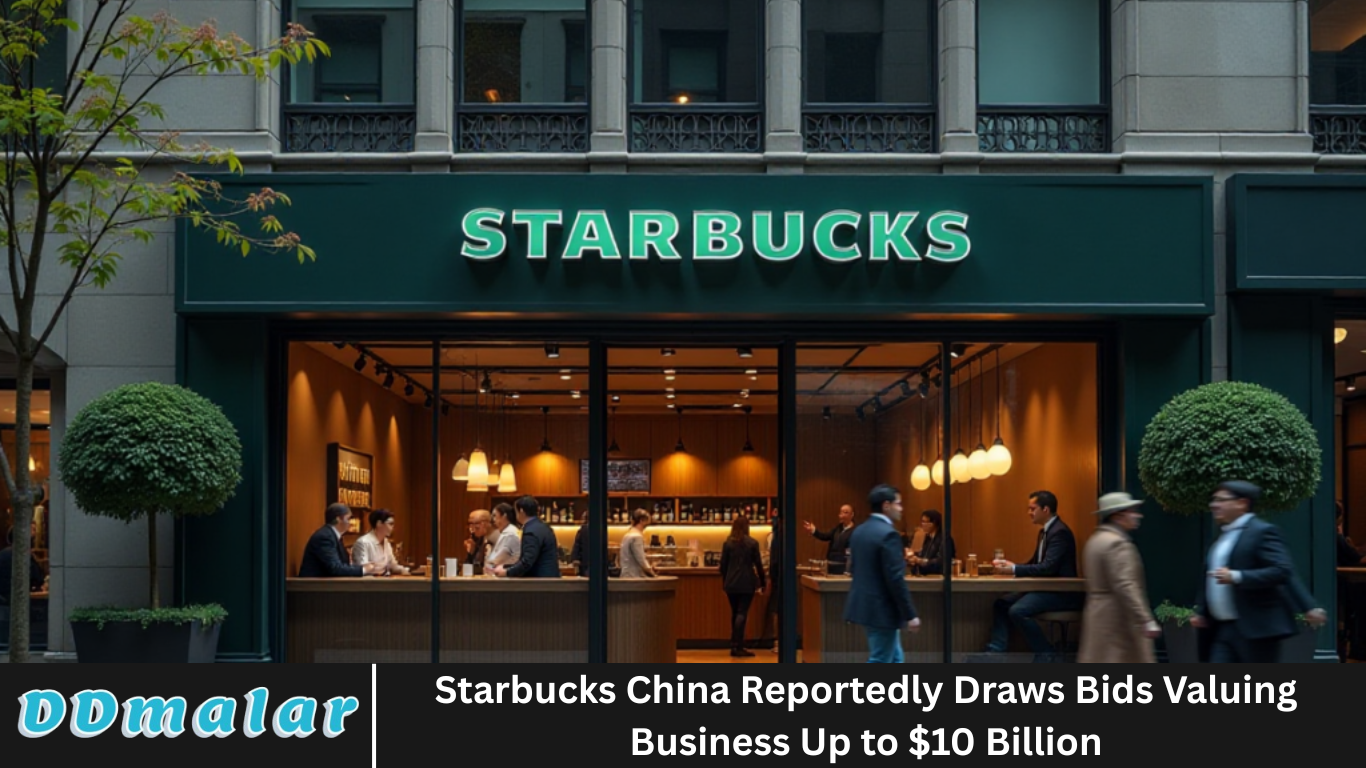
Starbucks Corporation (NASDAQ: SBUX) is taking a strategic step in its second-largest market by exploring a partial sale of its China business, drawing particularly heightened interest. According to recent reports, nearly 30 domestic and international private equity firms have submitted non-binding bids, valuing the unit between US $5 billion and $10 billion.
Starbucks, the world’s largest coffeehouse chain, is making headlines once again—this time in its second-largest market, China. According to recent reports, the company is exploring a partial sale of its China operations and has already attracted strong interest from investors.
Private equity giants and local firms alike are bidding for a stake in the business, with valuations soaring as high as $10 billion. This strategic move comes as Starbucks grapples with slowing sales, rising competition from domestic brands like Luckin Coffee and Mixue.
More Read: Samsung Galaxy Z Fold 7 and Z Flip 7 Launch Event: How to Watch the Live Stream
Why Now? — The Strategic Context
China: A Key Market Facing Headwinds
Since its 1999 debut, Starbucks has aggressively expanded in China, establishing over 7,700 stores by early 2025. Despite this expansive footprint, the brand has struggled with declining market share—falling from about 34–42% in 2017–2019 to approximately 14% in 2024 .
Sluggish same-store sales and intensified competition have triggered a reevaluation of the business strategy by CEO Brian Niccol, who joined in September 2023.
Intensifying Local Rivalry
The emergence of domestic chains like Luckin Coffee, Cotti Coffee, and popular bubble tea brands like Mixue, Heytea, and ChaGee has significantly disrupted the market These local players offer competitive pricing, agile menu innovation, and digitally integrated ordering systems.
For instance, Mixue has scaled rapidly with a global presence of over 46,000 outlets and a $25 billion valuation. As a result, cost-conscious consumers have shifted preferences, pressuring Starbucks to cut prices and pursue strategic partnerships.
Operational and Financial Pressures
Operating costs in China have increased, and Starbucks posted first-ever drink price reductions (RMB 5 per iced beverage) in June 2025 — signifying a rare step for the premium brand. These developments have compelled the company to seek creative solutions, including finding a strategic partner to alleviate pressure and inject fresh capital.
The Stake Sale: Details and Participants
Valuation and Bidding Landscape
Reports highlight bids valuing Starbucks China between $5–10 billion, with expectations that successful offers will edge closer to the higher end. This valuation correlates with China contributing roughly 8–9% of Starbucks’ total global revenue — about $3 billion annually .
Prospective Buyers in the Fray
- Centurium Capital (significant investor in Luckin Coffee)
- Hillhouse Capital
- U.S.-based private equity giants Carlyle Group and KKR
Approximately 30 private equity firms have submitted non-binding proposals, and Starbucks aims to shortlist bidders within ~60 days, though closing the transaction is unlikely before the end of 2025.
Proposed Deal Structure
Starbucks aims to retain about 30% ownership in the Chinese operation. The remaining equity would be divided among selected bidders, with no single buyer exceeding 30%, approximating McDonald’s 2017 partial sale strategy in China.
Strategic Rationale
Preserve Strategic Flexibility
By maintaining meaningful ownership, Starbucks retains influence over brand direction, quality control, and market positioning, while sharing risk and gaining capital to reinvest.
Access Local Expertise and Resources
Partnering with domestic firms like Centurium or Hillhouse brings China-specific insights and operational capabilities, potentially boosting digital integration, menu innovation, supply chain efficiency, and pricing strategies.
Battling Cost-Sensitive Competition
Cheaper local competitors set aggressive price points (e.g., RMB 2–5 cups vs. Starbucks’ RMB 20+). Strategic investors can help optimize pricing models, reduce costs, and assemble loyalty tactics aligned with local expectations .
Unlock Capital for Global and Local Growth
The capital influx can be channeled into expanding digital services, remodeling stores, strengthening supply chain logistics, or entering new regional sub-markets. The move echoes McDonald’s success, which initially sold a stake in 2017 and later rebought portions to leverage growth from China .
Key Challenges and Considerations
Valuation Pressure
China’s sluggish same-store sales (~–14% in Q3 2024) and shrinking market share complicate achieving a $10 billion valuation. Starbucks might postpone the sale if bids underperform relative to internal targets
Regulatory & Cross-Border Complexity
The deal must traverse China’s foreign exchange controls, antitrust regulations, and cross-border capital approval from the U.S. Treasury — a potentially prolonged and complicated process .
Brand Integrity vs. Expansion Speed
Over-fragmenting ownership risks diluting brand standards—quality, store aesthetics, and global consistency. Starbucks must ensure aligned visions between partners and its headquarters .
Potential Investor Overlaps
Centurium Capital’s stake in rival Luckin Coffee raises questions around competitive overlap. Starbucks must ensure intellectual property and customer data are protected.
Market & Investor Reaction
Stock Market Response
Following the reports, Starbucks stock saw a ~2% intraday gain, adding to a ~4% YTD rise. The optimism reflects investor approval of monetizing China while retaining a stake.
Global PE Investor Interest
Low-cost, high-growth markets like China remain attractive to private equity. The bidding activity indicates robust deal interest—firms are eager to deploy capital and signal deal-making capability amid economic slowdown.
Industry Buzz and Comparables
The transaction echoes parallels with McDonald’s 2017 and 2023 China equity restructuring. The strategic pivot trend is mirrored by Yum! Brands and others looking to localize their business models.
Outlook & Future Timeline
Short Term (Next 2 Months)
Starbucks is expected to shortlist bidders by September, focusing on price, structure, and value-add strategies .
Mid Term (End-2025 to Early 2026)
Comprehensive negotiations with selected firms, regulatory reviews, and due diligence will likely push deal finalization into late 2025 or early 2026 .
Long Term Outlook
A well-executed partnership could revitalize Starbucks’ China growth—slower, steadier expansion, store refresh initiatives, pricing adjustments, and deeper penetration into lower-tier cities with tailored offerings .
Frequently Asked Question
Why is Starbucks selling a stake in its China business now?
Because its China business has seen declining same-store sales and shrinking market share, prompting the company to seek fresh capital, local expertise, and strategic flexibility to counter competitors and reboot growth.
How much is Starbucks China worth according to recent bids?
Reported bids range from $5 billion to $10 billion, with many expected to lean towards the upper valuation .
Who are the key bidders?
Major contenders include Centurium Capital, Hillhouse Capital, Carlyle Group, and KKR, along with other unnamed domestic and international private equity firms.
How much of Starbucks China will the company retain?
Starbucks aims to keep around 30% of its China business, while the remaining equity is spread across multiple investors to avoid a single dominating stakeholder.
Will this deal protect Starbucks’ brand control?
Yes. By maintaining a significant equity position and structuring the deal to limit any individual investor’s control, Starbucks seeks to preserve influence over branding, quality, and strategic direction.
What’s the timeline for this transaction?
The company plans to shortlist bidders within ~2 months (around September 2025), with full deal completion unlikely before year-end, potentially extending into early 2026.
What are the potential risks in this deal?
Deal risks include regulatory hurdles (foreign exchange and approvals), valuation shortfalls, brand dilution, and managing investor overlaps—like Centurium’s stake in Luckin—while ensuring consistent market execution .
Conclusion
Starbucks’ move to sell a partial stake in its China operations—valued between $5–10 billion, backed by nearly 30 PE bids including Century, Hillhouse, Carlyle, and KKR—marks a bold strategic shift. By retaining a 30% stake and partnering with firms with strong local insight, Starbucks aims to address competitive pressure, digitize operations, innovate its offerings, and reignite growth.