

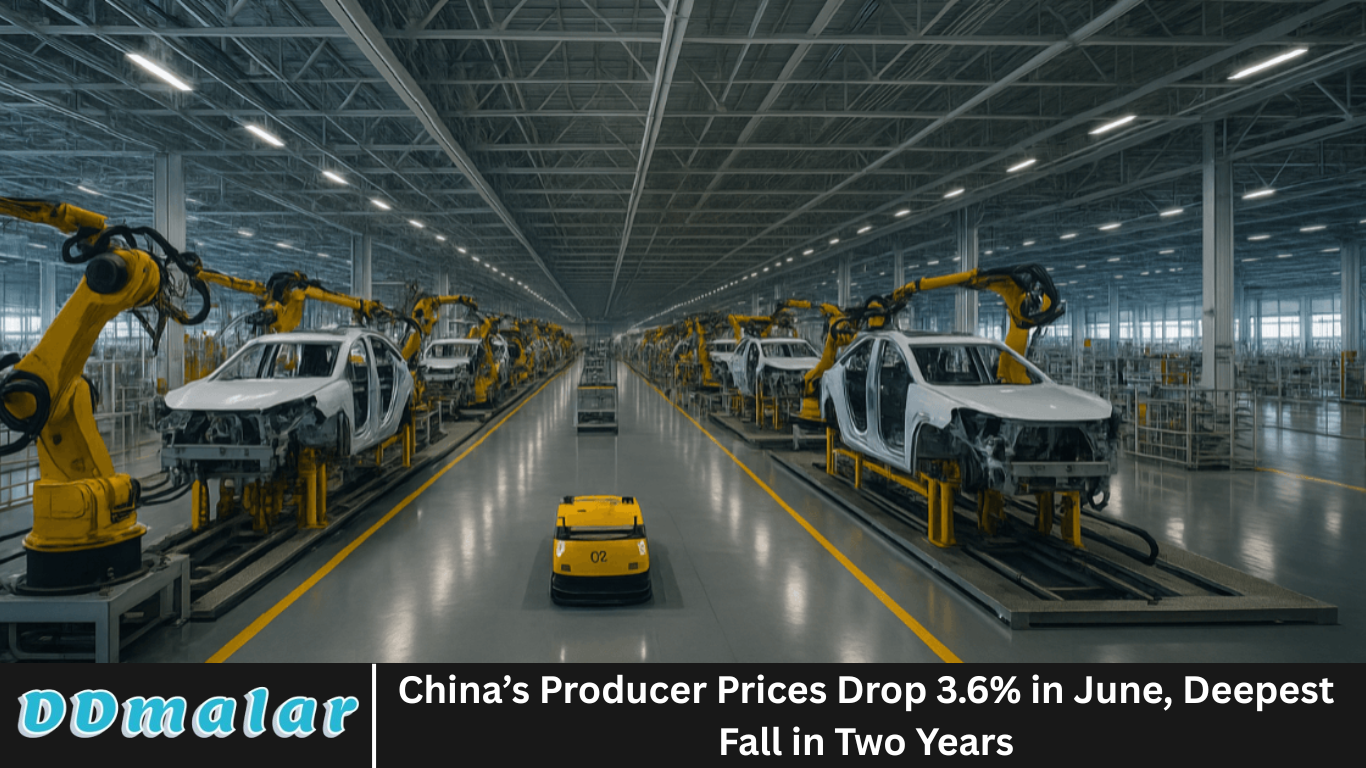
In June 2025, China recorded a steep 3.6% drop in producer prices year-on-year — the most significant decline in nearly two years. This data point, released by the National Bureau of Statistics (NBS), is stoking concerns about entrenched deflation in the world’s second-largest economy.
With global economic implications, falling producer prices (also known as the Producer Price Index or PPI) are sounding alarms across markets, signaling weak domestic demand and pressures on manufacturing.
This comprehensive article explores why China’s PPI is falling, what it means for local and global markets, and what steps policymakers might take to address the situation.
More Read: Jio IPO Faces Delay as Reliance Says Listing Unlikely in 2025
What Is the Producer Price Index (PPI)?
The Producer Price Index (PPI) measures the average change over time in the selling prices received by domestic producers for their output. It reflects wholesale price levels before goods reach consumers.
A declining PPI indicates that:
- Manufacturers are receiving less money for their products.
- There may be oversupply or weakening demand.
- Deflationary pressures are impacting economic sectors.
In China, the PPI is especially critical as the country remains a global manufacturing powerhouse. Falling producer prices often suggest deteriorating profit margins and rising stress in industrial sectors.
The 3.6% Decline: Breaking Down the Numbers
China’s PPI fell by 3.6% year-on-year in June 2025, following a 2.8% decline in May. This marks the 12th consecutive monthly drop and the largest single-month contraction since late 2023.
Sector Highlights:
- Metals and mining: Heavily impacted due to declining global commodity prices.
- Chemicals: Suffered from weak industrial demand.
- Electronics and tech: Experienced price stagnation amid global inventory gluts.
- Automobiles: Discounts and promotions continued to cut into factory-gate prices.
Why Are Producer Prices Falling in China?
Several interlinked factors are driving this deflationary trend
Weak Domestic Demand
Despite stimulus efforts, China’s post-pandemic recovery has been uneven. Consumer confidence is shaky, and private sector investment remains cautious. As a result, domestic buyers are not absorbing industrial output at healthy rates.
Global Slowdown
Sluggish demand from the U.S., EU, and ASEAN countries has affected Chinese exports. Factories are slashing prices to stay competitive abroad.
Real Estate Slump
China’s property sector, once a key driver of economic activity, remains in crisis. Construction-related industries (cement, steel, appliances) are suffering as new project starts dry up.
Supply Chain Gluts
Overproduction and inventory buildup in sectors like semiconductors and consumer electronics are forcing producers to cut prices to clear stock.
Technological Overcapacity
Rapid investment in AI, electric vehicles, and green tech has led to an oversaturated market in some sectors, sparking price wars and eroding margins.
Impacts on China’s Economy
Falling producer prices hurt business confidence, wages, and investment. Here’s how:
Profit Squeeze
Companies earning less per unit sold are hesitant to expand operations, hire workers, or invest in innovation.
Employment Risks
Small and medium-sized enterprises (SMEs) are especially vulnerable. With compressed margins, many are cutting jobs or freezing hiring.
Investment Caution
Low returns discourage capital expenditure. Foreign direct investment (FDI) could also suffer if profitability looks bleak.
Policy Headaches
China’s central bank and policymakers must balance stimulating growth without worsening debt or inflating asset bubbles.
Monetary and Fiscal Policy Responses
Rate Cuts and Liquidity Boosts
The People’s Bank of China (PBOC) has already signaled more interest rate cuts and reduced reserve requirements for banks to stimulate lending.
Infrastructure Spending
Beijing is accelerating infrastructure investments, especially in transportation, energy, and digital sectors, to revive industrial demand.
Consumer Stimulus
Local governments are issuing consumption vouchers, subsidies for appliance trade-ins, and discounts to encourage spending.
Targeted Support
Special assistance is being provided to strategic sectors such as green energy, semiconductors, and AI to weather price pressures.
How the Global Economy Is Affected
China’s deepening producer price deflation is not just a domestic story. It has ripple effects worldwide:
Lower Export Prices
Countries importing Chinese goods may benefit from lower costs in the short term, helping ease their own inflation.
Commodity Prices Under Pressure
Weaker industrial demand from China reduces global prices of raw materials like copper, coal, and crude oil.
Currency Volatility
The deflation narrative pressures the yuan (RMB), which could trigger trade frictions or competitive devaluations.
Global Growth Risks
Slower growth in China can affect multinational corporations, emerging markets dependent on Chinese demand, and global supply chains.
China’s Deflation: A Broader Economic Challenge
China is also experiencing consumer price stagnation. The Consumer Price Index (CPI) in June rose only 0.2% year-on-year, far below the government’s 3% annual inflation target.
This dual deflation — in producer and consumer prices — signals:
- Weak transmission of monetary stimulus to end demand.
- Structural economic challenges, including debt overhang and demographic decline.
- The risk of Japan-style long-term stagnation if not addressed effectively.
Analyst Perspectives and Market Reaction
Market Response:
- Shanghai Composite dropped modestly following the PPI release.
- The offshore yuan briefly weakened against the U.S. dollar.
- Bond yields fell as investors priced in further easing by the PBOC.
Analyst Viewpoints:
- Nomura: Warns of entrenched deflation and calls for “unprecedented stimulus.”
- Goldman Sachs: Sees structural deflation risks and suggests focusing on household income support.
- Moody’s: Flags potential credit risks for heavily leveraged industrial firms.
Outlook for the Second Half of 2025
While the government is likely to intensify stimulus in the coming months, recovery will depend on:
- Confidence Restoration: Boosting private sector and household confidence is key.
- Global Demand Rebound: Improvement in Western economies could help China’s export engine.
- Real Estate Stabilization: Preventing further property sector collapses is essential.
- Structural Reforms: Rebalancing the economy toward services and consumption remains a long-term goal.
Frequently Asked Question
What is causing China’s producer prices to fall?
China’s producer prices are falling due to weak domestic and global demand, excess industrial capacity, the property sector downturn, and a global slowdown affecting exports.
How does the drop in producer prices affect consumers?
While consumers may benefit from lower prices in the short term, long-term deflation can hurt wages, employment, and economic stability.
Is deflation bad for the economy?
Persistent deflation discourages spending and investment. It can lead to lower profits, job losses, and prolonged economic stagnation.
How is the Chinese government responding?
The government is using monetary easing (interest rate cuts), fiscal stimulus (infrastructure projects), and targeted support to counter deflationary pressure.
What does this mean for global markets?
China’s price cuts can reduce global inflation temporarily, pressure commodity prices, and impact trade balances and foreign exchange markets.
Could China face a deflationary spiral like Japan?
While comparisons are common, China’s economic model is different. Still, prolonged deflation risks exist if stimulus fails to generate real demand.
Will producer prices continue to fall in 2025?
Analysts expect continued pressure in the short term. However, if stimulus measures gain traction and global demand improves, a modest recovery is possible by late 2025.
Conclusion
China’s 3.6% drop in producer prices in June 2025 is a flashing red signal of ongoing deflationary challenges. As the backbone of global supply chains and a critical driver of world trade, China’s economic health matters deeply — not just to its own citizens, but to consumers, companies, and policymakers worldwide. Navigating deflation will require a delicate balance of short-term stimulus and long-term structural reform. Whether Beijing can revive confidence and demand fast enough remains the pressing question for the months ahead.